Using Our P3 Science Mindmap to Boost Your Child’s Revision
Starting Primary 3 Science is an exciting milestone, but it can also feel a bit overwhelming for both students and parents. Suddenly, your child is introduced to new topics like Diversity, Cycles, and Systems, and they are expected to remember specific scientific terms and keywords.
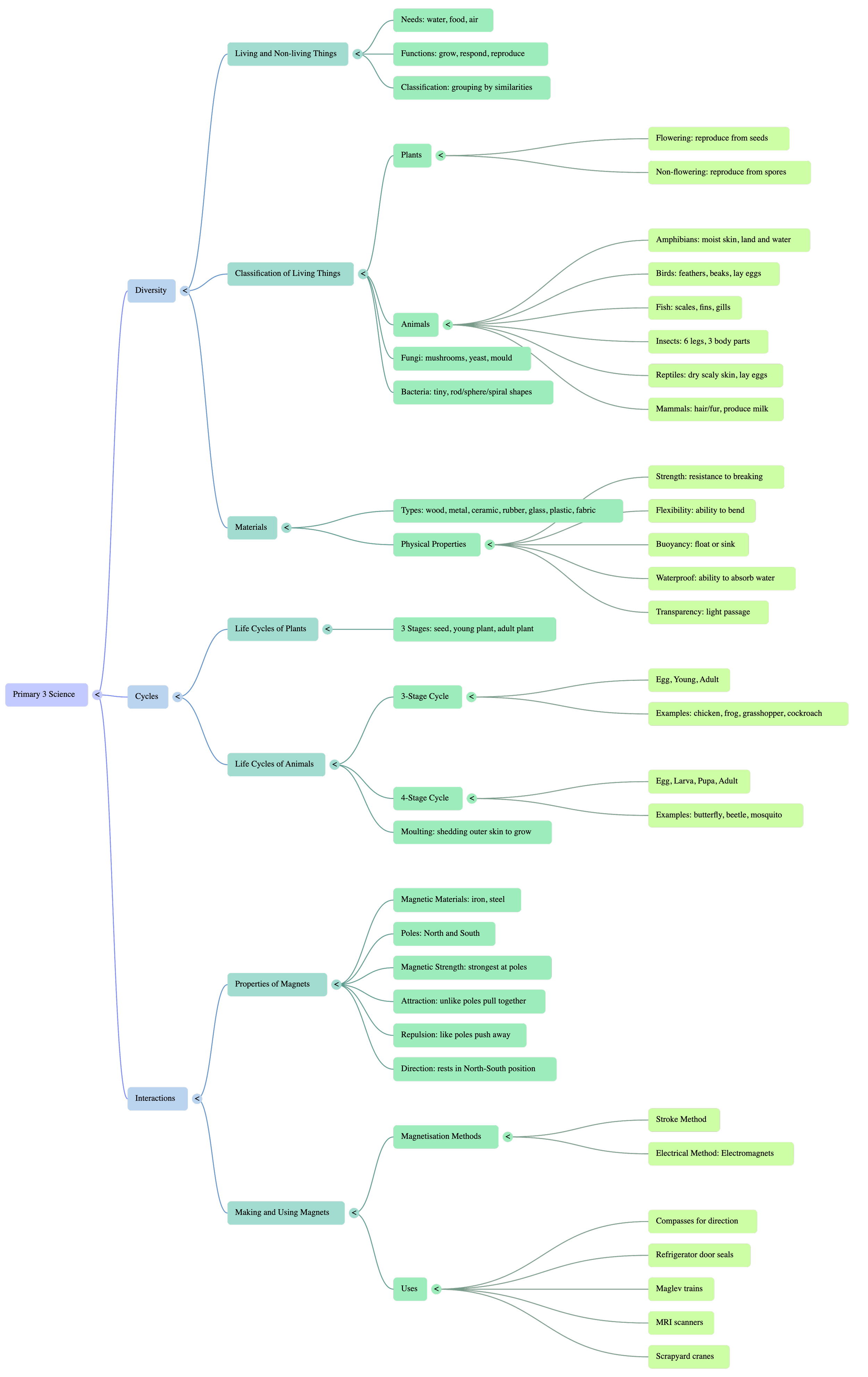
To help make this transition smoother, we’ve created a comprehensive P3 Science Mindmap for your child.
But a mindmap isn’t just a pretty poster to look at—it is a powerful, active learning tool! Here is how you can help your child utilize it to ace their revision.
1. Use the "Hide and Seek" Method for Active Recall
Staring at a mindmap for ten minutes doesn't help information stick. Instead, turn it into a game of active recall (testing the brain to fetch the information).
How to do it: Cover up parts of the mindmap with sticky notes. For example, cover the "Characteristics of Fungi" branch. Ask your child, "Can you name three things that make a mushroom different from a plant?"
The Goal: Once they answer, peel off the sticky note to let them self-check. This instant feedback builds massive confidence.
2. Master Section B Open-Ended Questions (OEQs)
The biggest struggle for P3 students isn't understanding the science; it's explaining it using the right keywords to score full marks in Section B. Your mindmap is a cheat sheet for these exact words.
How to do it: Pick a central concept from the mindmap, like "Insects." Look at the connected keywords (e.g., three body parts, six legs, outer covering of chitin/exoskeleton).
The Goal: Practice turning those isolated mindmap bubbles into complete sentences. Ask your child to answer: "Why is a spider not an insect?" Guide them to use the mindmap to say: "An insect has six legs, but a spider has eight legs."
3. The 5-Minute "Brain Dump" Warm-up
Before your child sits down to do a practice paper or assessment book chapter, use the mindmap as a quick mental warm-up.
How to do it: Give your child a blank piece of paper. Point to a main branch on the mindmap (e.g., "Materials") and let them look at it for 30 seconds. Then, hide the mindmap and give them 2 minutes to scribble down every word, property (like flexible, waterproof, strong), or example they can remember.
The Goal: This primes their brain and loads the relevant scientific concepts into their short-term memory right before they start practicing.
4. Track Weak Spots (The Traffic Light System)
Not all topics are created equal. Your child will naturally find some easier than others. Use the mindmap as a visual progress tracker. Have your child use highlighters to color-code the branches:
🟢 Green: "I know this so well I could teach it to my soft toys!"
🟡 Yellow: "I understand it, but I sometimes forget the exact keywords."
🔴 Red: "I’m confused by this and need to re-read the textbook."
This prevents "revision overwhelm." Instead of studying the whole syllabus, your child can look at the mindmap and immediately see, "Today, I just need to turn this red branch into a yellow one."
💡 Pro-Tip for Parents: Print the mindmap out in A3 size if possible. Stick it on the bedroom wall or the fridge at eye level. Daily, casual exposure to the visual branches helps the brain map out the syllabus effortlessly over time!
Ready to supercharge your child's Science revision?
Download our free P3 Science Mindmap below and use these 4 strategies to see an immediate difference in how they retain information!