
More Than Just Memorising: 5 Key Strategic Focus in Singapore’s New Primary Science Syllabus
For decades, the standard perception of Primary Science in Singapore has been one of rigid taxonomies and the meticulous memorization of "keywords" to satisfy mark schemes. However, as a curriculum strategist, I see the Ministry of Education’s (MOE) latest direction as a clear reflection of a steady, long-term trajectory.
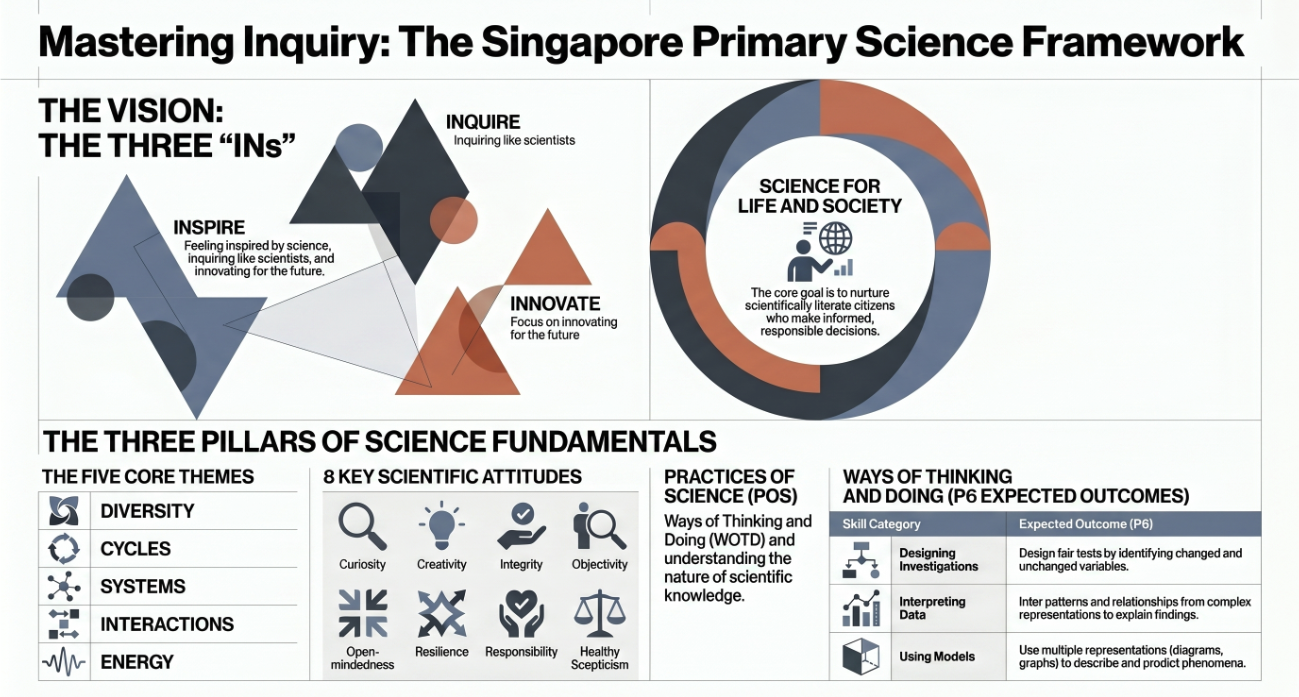
This consistent direction actually took root with the previous syllabus revision back in 2017. Rather than a sudden departure, the current Science Syllabus—implemented with the 2023 Primary Three cohort and culminating in the 2026 PSLE—is a natural and deliberate continuation of that momentum. It represents a progressive deepening of a singular, enduring goal: moving steadily away from rote learning and further toward "Science for Life and Society."
The goal is to bridge the "Curiosity Gap"—the space between a child's natural wonder and the classroom’s academic requirements. This syllabus moves beyond the "lab coat" stereotype to develop students who do not just know science, but can navigate a world of misinformation through "Healthy Scepticism."
Here are the five strategic shifts that redefine what it means to be a science student in Singapore today.
1. Science is Officially a "Human Enterprise"
The most significant philosophical shift is the recognition that science does not exist in a vacuum. The new framework explicitly treats Science as a discipline requiring "Values, Ethics, and Attitudes."
Students are now expected to articulate ethical stances on Socio-Scientific Issues (SSI)—real-world problems with no single "right" answer. For example, in the PSLE 2014 paper (Q36), students are asked to analyse how global warming causes sea turtles to lose nesting beaches and how rising temperatures affect the gender balance of the population. This isn't just about biological facts; it is about the "human enterprise" of interpreting environmental ethics through data. By fostering "Open-mindedness" and "Integrity," the curriculum equips students to handle the "Nature of Scientific Knowledge" (NOS)—the understanding that while scientific knowledge is reliable and durable, it remains open to change in light of new evidence.
"Science... is in fact a human enterprise conducted in particular social contexts which involves consideration of values and ethics."
2. The "Spiral Approach" to Learning
To prevent "knowledge siloing"—where a student forgets Primary 3 Diversity the moment they begin Primary 5 Systems—the syllabus utilises a Spiral Approach. Core concepts are revisited with increasing depth, matching the child's cognitive development. This ensures gradual mastery rather than one-off rote learning.
The curriculum is built around five interlocking themes, governed by "Essential Takeaways" directly from the MOE framework:
Diversity: There is a great variety of living and non-living things; classification helps us understand this variety and the importance of maintaining it for survival.
Cycles: Repeated patterns of change, such as the water cycle. (Example: PSLE 2023 Q16 requires students to identify condensation as the specific process within the cycle that forms clouds).
Systems: A system is a whole consisting of parts that work together to perform functions (e.g., the Human Respiratory System or Electrical Systems).
Energy: Energy is required for things to work and can be converted between forms. (Example: PSLE 2024 Q15/Q23 explores how solar panels receive light energy to produce electricity for mobile phones).
Interactions: Actions between living and non-living things have impacts; understanding this is the key to conservation.
3. Moving Beyond the Classroom: The "Three INs" Vision
The vision for the 2026 syllabus is distilled into three pillars: Inspire, Inquire, and Innovate. This framework is designed to transition students from passive consumers of facts to active contributors to STEM research and enterprise.
Inspire: Fascinating students with how everyday phenomena have scientific connections.
Inquire: Developing the "spirit of scientific inquiry." This is explicitly linked to the 21st Century Competencies (21CC) of Critical Thinking and Communication. A key cognitive skill now taught is the ability to "suspend judgment" when evidence is lacking—a strategic defense against the "post-truth" era.
Innovate: Applying science to generate creative solutions for real-world problems. This moves the needle from "knowing" to "doing," preparing students for technological disruptions like AI and climate change.
4. The "Practices of Science" Over Rote Results
The core of the new curriculum is the Ways of Thinking and Doing (WOTD). The MOE has shifted the focus from the "right" answer to the process by which that answer is found. The "Practices of Science" (POS) now categorise student activity into three areas:
Investigating: Posing questions, defining problems, and designing fair tests.
Evaluating and Reasoning: Posing arguments based on evidence and making informed decisions.
Developing and Evaluating Solutions: Using models to describe and predict phenomena.
A classic example of this is found in PSLE 2014 Q32, where a student, Liping, conducts an experiment with roots and oil. The student is not just asked for a result, but must explain the purpose of the oil layer and analyse the water level (H) to infer the function of the roots. This demonstrates the Nature of Scientific Knowledge (NOS): that science is an "evidence-based, model-building enterprise" that assumes "natural causes, order, and consistency."
"Science is an evidence-based, model-building enterprise to understand the real world."
5. Assessment is Becoming Multimodal (and Creative)
Strategic assessment is no longer confined to the OMR sheet. While the PSLE remains the national standard, school-based assessments now include a 15% to 30% weighting for performance-based modes. This provides a "comprehensive picture" of a student's development before they reach high-stakes testing.
These multimodal assessments include:
Drama / Show and Tell: Expressing scientific processes (like the movement of blood through the heart) through movement.
Model-making: Building physical structures to demonstrate system functions. For instance, a student might be tasked with creating a mechanism similar to the "Bobbing Carrots" game in PSLE 2021 Q38, using an iron rod, a spring, and a magnetic coil to demonstrate how an electromagnetic system works.
Reflections and Journals: Encouraging metacognition—where students track what they have learned and what they are still curious about.
Conclusion: A Future-Ready Foundation
The 2026 Primary Science Syllabus is a strategic briefing for the next generation. By prioritising the "Practices of Science" and ethical reasoning over simple fact-retrieval, Singapore is ensuring its students are ready for a world where AI can provide the "what," but humans must still decide the "how" and "why."
As we look toward this new era of scientific education, we must ask: In an age of infinite information, is scientific literacy defined by what we remember, or by the integrity and "healthy scepticism" we apply to the evidence before us?